
26 July 2026 · 5 min read
Denim fit guide for UK Shopify merchants
Unlock the secrets to perfect denim fit with our guide. Standardize measurements, enhance virtual try-ons, and reduce returns!
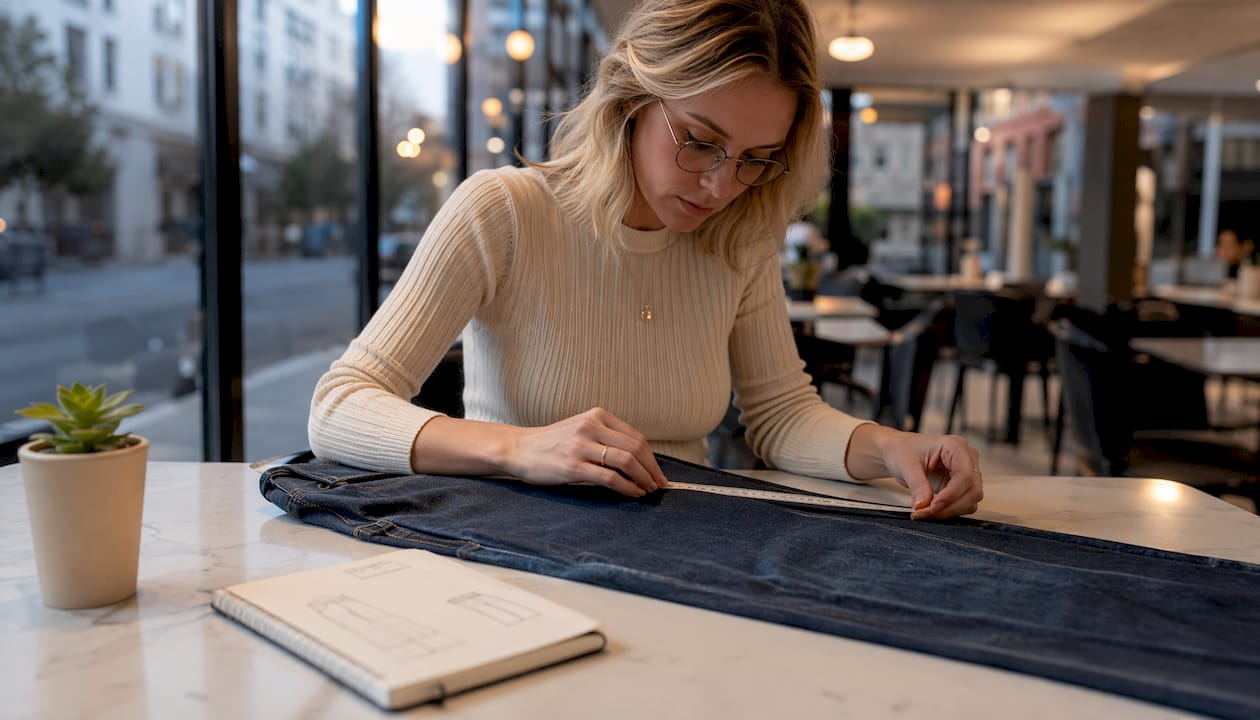
Denim fit guide for UK Shopify merchants
Start with standardised body and garment measurements on every denim product page, then run a short AI virtual try-on pilot on your top-selling SKUs. That combination addresses the root cause of most denim returns before a parcel ever leaves your warehouse.
Three things to do this week:
- Standardise garment measurements. Publish W×L sizing, front and back rise in centimetres, inseam, thigh flat measurement, and fabric stretch percentage on every denim PDP.
- Add rise and inseam data. Vague labels like “mid-rise” are not enough. Customers need numbers they can cross-reference against a pair they already own.
- Enable size recommendation or virtual try-on. Even a basic widget on your top five denim SKUs will generate usable return-rate data within weeks.
Quick checklist: Display W×L and rise measurements. Show model height, weight, and size worn. State fabric composition and stretch %. Link to a size-recommendation widget. Include free-returns messaging and a care/returns policy link.
Poor fit drives the majority of fashion returns , and denim is the category where fit complexity is highest. Rise variation, fabric rigidity, and the gap between labelled size and actual garment dimensions all compound each other.
Table of Contents
- What every merchant needs to know about denim fit
- Which measurements to collect and display on UK product pages
- How to present fit information on product pages
- How AI virtual try-on reduces denim returns
- Step-by-step implementation for UK Shopify merchants
- How to run a pilot and measure success
- Top denim fit mistakes retailers make
- Key takeaways
- Why measurement discipline matters more than the technology
- Fewer denim returns start with one photo
- Useful sources
What every merchant needs to know about denim fit
Denim fit is determined by four variables: silhouette, rise, fabric composition, and ease. Get one wrong on a product page and you generate a return.
Silhouettes define the shape of the leg from hip to hem. A straight cut maintains a consistent width from thigh to ankle. Slim tapers slightly through the thigh and knee. Tapered cuts are wider at the thigh and narrow sharply toward the hem. Relaxed fits carry extra width throughout. GQ editors note that silhouette choice is the primary determinant of perceived fit, and that large retailers function as useful fit benchmarks precisely because their ranges are wide and their fit notes consistent.
Rise controls coverage and waistband security more than the waist number itself. Lee’s guidance is direct: a higher rise reduces gaping; a lower rise gives a more relaxed feel, but back rise is particularly important for seated comfort. A mid-rise typically measures 9–10 inches, a high rise is 11 inches, and the back rise should be 2–3 inches longer than the front rise to prevent the waistband from slipping when a customer sits down.
Fabric composition is where most merchants under-communicate. Denim expert Thomas Stege Bojer identifies fabric weight and composition as the most common shopper blind spots. Heavy 100% cotton in a slim cut is far less forgiving than a lighter stretch blend. The practical balance most practitioners recommend is mostly cotton with a small percentage of elastane. Above that threshold, fabrics tend to bag out faster, which creates a different kind of return: the customer liked the fit at purchase but not after three washes.
Pro Tip: Publish fabric weight in grams per square metre (GSM) alongside composition. A 12 oz rigid denim and a 9 oz stretch blend behave entirely differently in a slim silhouette, and customers who know this return less.
Which measurements to collect and display on UK product pages
There is no universal sizing standard. A UK size 12 often maps to roughly a 30-inch waist across high-street brands, but inch-based W×L labelling is the most reliable reference point for customers buying online.
Body measurements to collect from customers
Ask customers to measure: waist (at the natural waist), hips (at the fullest point), front rise, back rise, inseam (crotch to desired hem), thigh circumference, and hem width preferences. A soft tape measure, natural posture, and three core numbers (waist, hip, inseam) form the practical base for size mapping.
Garment measurements to publish on PDPs
Measure garments flat and publish: labelled W×L, front rise, back rise, inseam, thigh flat, leg opening, and fabric stretch percentage. Levi’s measurement guidance confirms that waist measurements shift with rise, so publish rise-specific waist figures rather than a single number.
PDP data table template
Measurement How to measure Unit Waist (W) Lay flat, measure full waistband, double it inches / cm Front rise Waistband top to crotch seam, front inches / cm Back rise Waistband top to crotch seam, back inches / cm Inseam Crotch seam to hem, inside leg inches / cm Thigh (flat) Widest point of thigh, measured flat inches / cm Leg opening (flat) Hem width, measured flat inches / cm Fabric stretch % Stretch fabric 10 cm, measure extension %
How to present fit information on product pages
The goal is to give customers a direct comparison path: their body measurements against your garment measurements, with a known-fit pair as the reference. Fit notes and model size callouts create that trust.
PDP structure that reduces uncertainty:
- Place the garment measurement table above the fold on mobile, immediately below the size selector.
- Add a “model is 5’9”, 32" waist, wearing W32 L32" callout adjacent to every hero image.
- Include a short fit note (two sentences maximum): intended fit, and whether to size for hips or waist.
- State fabric composition and a one-line behaviour note (“this fabric has minimal stretch; size up if between sizes”).
- Link to your returns policy and size-recommendation widget from the same block.
Photography: shoot front, side, and back on at least two different body types per style. Rise-focused images (showing where the waistband sits relative to the navel) answer a question most customers have but rarely ask. Multi-size model shots, where you show the same style on a size 10 and a size 16, reduce bracketing and the associated reverse logistics cost.
How AI virtual try-on reduces denim returns
AI try-on maps a customer’s body measurements to garment measurement metadata and renders a photorealistic image of the fit. The specific denim problems it addresses most effectively are rise mismatch, hip-to-waist gap, wrong inseam length, and misread fabric stretch expectations — the four issues that account for the bulk of fit-driven returns.
The KPIs to track are return rate by fit reason, conversion lift on PDPs with try-on enabled, average order value, and cost per return. Each returned denim item carries hidden costs of roughly £25 once picking, inspection, and restocking are included. That figure is your baseline for any ROI calculation.
Pro Tip: Under UK GDPR, customer photos are personal data. Confirm with your legal team that your privacy notice covers image processing for try-on purposes before you go live. Most Shopify-compatible solutions process images server-side and do not store them, but you still need to disclose this in your policy.
Body-measurement AI derives fit predictions from eight body measurements rather than purchase history, which makes it significantly more accurate for new customers who have never bought from you before.
Step-by-step implementation for UK Shopify merchants
- Audit your current size content. Identify your top 10 denim SKUs by return rate. Note which ones lack garment measurements, rise data, or model callouts.
- Gather garment measurement data. Measure each SKU flat using the protocol above. Record all seven dimensions per size in a spreadsheet.
- Update PDPs. Add the measurement table, model callout, fit note, and fabric behaviour statement to each audited PDP.
- Choose your integration route. Install a Shopify app for a no-code setup, or use a JavaScript snippet for a custom storefront. Connect to Klaviyo if you want fit-preference data flowing into your CRM segments.
- Wire analytics. Tag return reasons in your returns portal so you can isolate fit-driven returns from preference returns. This is the baseline you will compare against post-pilot.
- Train customer service. Brief your team on how to read garment measurements and how to guide customers through self-measurement. Update your return codes to capture “fit: rise”, “fit: thigh”, and “fit: inseam” separately.
- Calculate your ROI threshold. Multiply your monthly denim return volume by £25. That is your cost floor. A pilot that moves return rate by even a few percentage points will typically cover its subscription cost within the first month.
For a mid-size Shopify merchant processing a substantial number of denim returns each month, the hidden cost baseline is significant. A meaningful reduction in fit-driven returns pays back the technology investment quickly.
How to run a pilot and measure success
Run a 6–12 week A/B test on a single denim family. Control pages get the updated measurement table and model callouts. Treatment pages add AI virtual try-on and a size-recommendation widget.
Timeline:
- Weeks 0–2: Onboarding, PDP updates, analytics tagging, baseline data capture.
- Weeks 3–8: Live test. Do not change any other PDP elements during this period.
- Weeks 9–12: Analysis and roll-out decision.
Pilot results tracking table
Metric Baseline (control) Pilot (treatment) Target delta Return rate (fit reason) Record % Record % Relative reduction Conversion rate Record % Record % Lift Average order value Record £ Record £ Lift Cost per return £25 baseline Record £ Reduction
Sample size: aim for at least 500 sessions per variant before drawing conclusions. Fewer sessions produce noisy results that do not support a roll-out decision.
Top denim fit mistakes retailers make
- Publishing only labelled sizes. Fix: add W×L and front/back rise in centimetres to every denim PDP immediately.
- Vague rise labels. “Mid-rise” means nothing to a customer who does not know your brand’s patterning conventions. Fix: publish front rise and back rise as exact figures, and add a one-line cross-reference tip (“if your current jeans have a 10-inch front rise and fit well, this style will feel similar”).
- Ignoring fabric behaviour. A customer who buys a rigid 100% cotton slim fit expecting stretch will return it. Fix: state composition, GSM where possible, and expected behaviour after washing.
- Single-size, single-model imagery. Fix: add at least two model sizes per style and include a back-view shot that shows rise and seat fit clearly.
Pro Tip: Add a “compare to a pair you own” prompt on your PDP. Ask customers to measure their best-fitting jeans and compare those numbers to your garment measurements. This single addition reduces sizing uncertainty without any technology investment.
Key takeaways
Combining standardised garment measurements with AI virtual try-on is the most direct route to reducing denim returns and lifting conversion on Shopify.
Point Details Publish garment measurements first Add W×L, front/back rise, inseam, and thigh flat to every denim PDP before any other change. Rise matters more than waist label A mid-rise is typically 9–10 inches, a high rise is 11 inches, and the back rise should be 2–3 inches longer than the front rise; publish both figures so customers can cross-reference. Apply the 2% elastane rule Around 98% cotton and 2% elastane balances comfort and shape retention; state this on the PDP. Cost-per-return baseline is £25 Use £25 per returned item as your ROI floor when calculating pilot payback. Garmcheck for Shopify pilots Garmcheck maps body to garment measurements and generates a photorealistic try-on from one photo, with Shopify app install and Klaviyo integration.
Why measurement discipline matters more than the technology
The merchants who get the most from AI try-on are not the ones who install it fastest. They are the ones who arrive with clean garment measurement data, tagged return reasons, and a clear baseline. The technology surfaces what the data already contains. If your PDPs carry vague rise labels and no fabric notes, an AI layer will reduce uncertainty slightly but not structurally.
The conventional wisdom is to treat virtual try-on as a conversion tool. That framing is not wrong, but it undersells the operational benefit. The real gain is in what you learn: which rise dimensions drive returns, which silhouettes generate the most bracketing, and which fabric compositions produce the most post-wash complaints. That data is worth more than any single conversion lift, because it feeds back into your buying and product development decisions.
Start with a single denim family, measure everything, and let the pilot tell you where the fit problems actually live before committing to a full roll-out.
Fewer denim returns start with one photo
Denim is the hardest category to fit online, and the merchants who solve it gain a structural advantage: lower reverse logistics costs, higher repeat purchase rates, and customers who trust the size they order. Garmcheck gives UK Shopify merchants a direct route to that outcome.
Upload one front-facing photo and Garmcheck generates a photorealistic try-on image in under ten seconds, derived from eight body measurements mapped against your garment data. Install takes minutes via the Shopify app store. Klaviyo integration means fit preferences flow directly into your CRM segments. Returns analytics show you which SKUs are driving fit-driven returns and why.
Start your 14-day free trial and run your first denim pilot this month. No engineering resource required.
Useful sources
- Levi’s: how to measure jeans — measurement protocol for waist, inseam, and rise
- Vogue UK: guide to buying jeans — sizing variation across UK high-street brands
- Denim Hunters: jeans fit guide for men — fabric weight and composition guidance from Thomas Stege Bojer
- Lee: denim fit guide — rise measurement standards and comfort guidance
- Tellar: how to find your size in jeans without trying them on — customer self-measurement protocol
- Miolook: how to choose jeans for your body type — rise patterning metrics and the 2% elastane rule
- GQ: best jeans for men tested and reviewed — silhouette benchmarking and editorial fit notes
- Garmcheck: hidden cost of a fashion return — £25 per-return cost model for ROI calculations
- Garmcheck knowledge centre — technical references and merchant guides
Recommended
- AI Size Recommendation for Fashion — Get the Right Size First Time | GarmCheck
- Virtual Try-On for Fashion Retailers | GarmCheck
- Why 72% of fashion returns are fit problems — and what to do about it — GarmCheck
- Articles — GarmCheck on fit, returns and virtual try-on
Ready to reduce returns?
Start your 14-day free trial
See GarmCheck on your own products. No credit card required.